Arrival in Rural Burgundy
It was late—approaching midnight—when fatigue finally caught up with us. We had been driving from Lille in northern France, heading toward the Côte d’Azur in the south.
At the next exit, I made a spontaneous decision. The sign read: Dijon 42 km, Pouilly-en-Auxois 8 km. We left the main road and continued through the dark summer countryside, passing through silent villages where not a single person could be seen.
With every kilometer, the sense of isolation deepened.
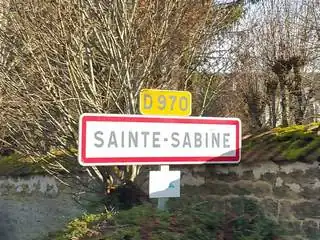
Then, barely visible in the darkness, a small roadside sign appeared: “Château de St. Sabine – 8 km.” In need of rest, we followed the narrow, winding road into the unknown.
An Ominous First Impression
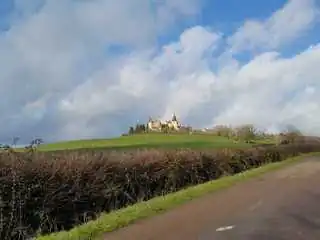
A large silhouette gradually emerged ahead of us. The structure was imposing—almost overwhelming in scale. There was no proper illumination, only a faint, flickering light.
We approached the arched entrance and rang the bell.
Suddenly, the stillness was shattered by deep, aggressive barking. The sound echoed through the darkness—powerful and unsettling, as though unseen guard dogs were circling nearby.
We drove into the courtyard and stopped near what appeared to be the main entrance. Yet no one came. No footsteps, no voices—only the relentless barking from somewhere out of sight.
The atmosphere felt distinctly uneasy.
A Strange Encounter
Moments later, a curtain shifted behind the entrance. A figure appeared, watching us from inside.
Without warning, the door opened. A small elderly woman stepped forward, dressed in white. She addressed us in French: “Que voulez-vous? Manger, dîner, coucher?” — What did we want? To eat, dine, or stay the night?
For a brief moment, we hesitated. The scene felt surreal, reminiscent of a historical novel. The setting, the figure, the silence—it all seemed detached from modern reality.
Eventually, we stepped out of the car, cautiously, still half-expecting the unseen dogs to appear.
Inside the Château
The woman introduced herself as Madame de Bourgoise, a relative of the château’s owner. With no realistic alternative, we agreed to stay.
Inside, the atmosphere intensified. At the base of a wooden staircase stood two taxidermied wolves, their exposed fangs frozen in a permanent snarl. The display added to the already unsettling environment.
By candlelight, Madame led us upstairs. The château, we learned, dated back to the 17th century and had once served as a hunting residence for French nobility.
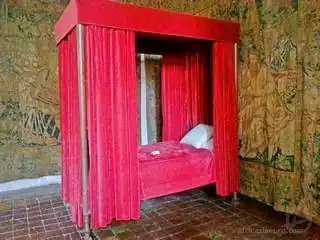
She opened the door to a vast bedroom. At its center stood a grand four-poster bed, draped with a canopy—large enough to belong to a figure such as Napoleon Bonaparte.
Nightfall and Reflection
Fatigue soon outweighed unease.
I opened the window. Outside, a lake shimmered softly under the moonlight. The air was fresh and still, interrupted only by the distant sound of cowbells.
Gradually, the tension faded. The château no longer felt threatening—only remote, historic, and deeply atmospheric.
Leaving the window open, I fell asleep.
Gallery
France, Bourgogne — AFRICASIAEURO